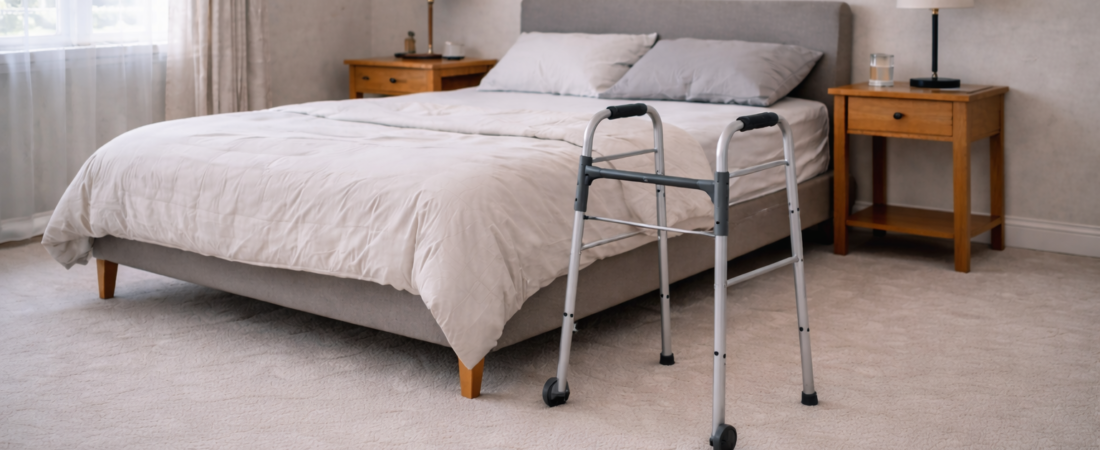
Transfer equipment and aids are often introduced to make movement safer and more manageable. When used appropriately, they can support balance, reduce strain, and increase confidence during transfers.
However, equipment alone does not make a transfer safe. Safety depends on how well the aid matches the person’s ability, the environment where it is used, and how it fits into everyday movement patterns.
Understanding the role of transfer equipment helps prevent overreliance, misuse, and unexpected risks.
Equipment Supports Movement, It Does Not Replace It
Transfer aids are most effective when they are used as part of overall mobility transfer safety, rather than relied on in isolation to compensate for risk.
Even with equipment in place, the person transferring still needs to manage balance, timing, and body position. Relying on an aid to compensate for instability or fatigue without adjusting technique or assistance can increase risk rather than reduce it.
Equipment works best as part of a broader safety approach.
Matching Equipment to the Transfer Situation
Different transfer situations place different demands on the body.
An aid that works well in one setting may not be appropriate in another. Space constraints, surface height, and direction of movement all influence whether equipment provides support or creates obstacles.
Matching the aid to the specific transfer context is more important than the type of equipment itself.
Proper Setup Is Essential
Transfer equipment must be positioned and adjusted correctly to be effective.
Poor placement, incorrect height, or unstable positioning can interfere with movement and create unexpected challenges mid-transfer. Equipment should feel secure and predictable before movement begins.
Taking time to check setup reduces the need for last-minute adjustments.
Equipment Can Change Movement Patterns
Introducing an aid often changes how a transfer is performed.
Grip points, leverage, and body alignment may shift when equipment is used. These changes can be helpful, but they also require awareness and adaptation. Moving in the same way as before without accounting for the equipment can increase strain or imbalance.
Allowing time to adjust to new movement patterns improves safety.
Overuse Can Reduce Awareness
Using equipment in situations where it is not needed can reduce attentiveness to movement.
When aids are relied on automatically, changes in ability or environment may be missed. This can lead to delayed responses when conditions change or when the equipment is unavailable.
Regularly reassessing whether equipment is still appropriate helps maintain awareness.
Equipment Needs Can Change Over Time
Transfer equipment needs are not static.
As strength, balance, confidence, or fatigue levels change, the usefulness of certain aids may increase or decrease. Equipment that once provided support may later become restrictive, or new needs may emerge.
Periodic reassessment ensures equipment continues to support safe movement rather than limit it.
Equipment Is One Part of Transfer Safety
Transfer equipment can be a valuable support, but it is only one element of mobility transfer safety.
Safe transfers depend on a combination of environment, movement principles, appropriate assistance, and awareness of change. Equipment is most effective when integrated thoughtfully into this broader system.
Understanding its role helps people make safer, more informed decisions in everyday transfers.